31.5.10

Knight vs. Ulysses

Two very noble men, two very important people of their time, 2 men with not enough respect or time for their sons, two warriors. The knight of the Canterbury Tales and Ulysses of the same-named dramatic monologue have more in common than meets the eye. So similar, in fact that how am I to decide between the pair? Lets start with basics, like how the knight is of a much lower standing than the King of Ithaca. But the knight appears to have a higher power on his side, having been said to be very pious and follow the laws of chivalry, where as the ancient Greek gods seems to always be squabbling as to whether Ulysses is a decent guy, it took 10 years for them to let him come home, and the knight could take advantage of that pretty quick. Besides who want to watch a fight that takes 10 years to resolve? ( But isn't that the plot of the Illiad?) Still Ulysses has an army of questionable size (size of Ithaca still undetermined), while the knight might be able to round up some soldiers of dubious ability and that would be it. Both men are determined, however, to make something of the rest of their short lifespans before they bite the dust, especially Ulysses, who is bored of his life in Ithaca. ( God it must be soooo boring to be a king and have everything done for you, I feel so bad...) But in the end only one will stand tall and be proclaimed winner.

And the winner is.....
Ulysses

While he might be a bit whiny about his first world problems, Ulysses does have the power and prestige to wipe out the knight. But, in fairness to the knight, he would give it his best shot and deny, even on his death bed,that he had ever been beaten, that it was "just a scratch". Hmm that reminds me of another knight, wonder who that could be?

27.5.10

Thomas Gray vs. Thomas Wyatt

It's time for the (2nd) battle of the Thomas's! Besides their names, the 2 didn't really have all that much in common, one was too busy pining over a girl to get anything done, and the other was obssessed with death, and spent his time pondering why some dead people were remembered more than others to get anything done. Now we have already established that Thomas Wyatt was a bit of a whiny prat who fancied himself in love with Anne Boleyn, who was conveniently married to the king so that Wyatt had the perfect excuse to never, ever talk to her. Well unless he wanted his head to be mounted above the good king's fireplace... And Thomas Gray, well he spent his days roaming graveyards, which eventually did pay off- Elegy Written in Country Churchyard is a very critically acclaimed piece even if the name is a bit wordy and has no mystery. But looking at is family, I can understand the guys obsession with death- he had 11 brothers and sisters who all died before the age of 5. If that were me, I would spend a lot of time in a graveyard too. But I don't have to, thanks to modern medicine ( and basic hygiene...)! So who should win, the morose man obsessed with the art of passing on, or the smitten sir, who did introduce the English to the sonnet, but died with little prestige to his name? Which should triumph, love or death, the sonnet or the lyric?

And the winner is......
Thomas Gray

While his Elegy may seem to be simply about how death conquers all, including the love that tears Thomas Wyatt apart, his message can be interpreted (only by English majors) as more than that, as a message to grapple life, and swallow your pride and go for your goal, and ignore the risks that might be there. The worst thing that could happen is that you could die, right? Which is a lesson that Mr. Thomas Wyatt could have used.

17.5.10

Nymph vs. Lamb

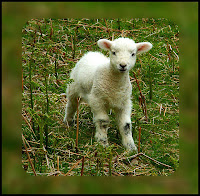
How could you fight this?
Now it is time for probably the most tame battle ever, the nymph (an old-timey way of saying a girl) versus the cute little lamb, who you will remember destroyed the tyger with his sunshine,optimism and butterflies. The nymph is made of some slightly harder stuff, having rejected the shepherd because he was too poor, which was pretty cruel if you ask me. But, she could be seen as being more than just a parasitic gold-digger, she could be seen as an optimist, that see will have other, better opportunities that will come her way. So if you skew your perspective just a little bit (which I can, and will), this becomes more than just a battle of a girl and a lamb, it becomes a battle of optimism, and which version will prevail. I, know pretty deep right? If that makes your head spin a little, you can just pretend that this never even happened.....
So on the one hand (or hoof?) there is the pure, simpleness of the lamb, child-like and innocent but full of naivety, and on the other hand there is the ambitious optimism (or greed) of a girl trying to be upwardly mobile, trying to assert her own place (which Gloria Steinem would have appreciated) . Which will triumph?

And the winner is......
The Lamb
I'm sorry, but the nymph was too greedy to win this metaphorical battle, I don't care how I spin it, she was horrible to the shepherd, and there is no excuse for treating him like that, no matter how much ambition you may have ( There's a life lesson in there somewhere...). And anyways, one look at an adorable little lamb (Mary's perhaps?) and the nymph would send up a white flag in defeat.

16.5.10

Mariner vs. Satan

After narrowly taking out what was probably his biggest opponent in round 1, Satan now has to face another difficult challenger-this time in the face of the Mariner. Now. things are much more interesting here, the Mariner seems  unable to die ( due to the whole albatross debacle) so he would not be subjected to Satan's wrath the way us, mere mortals are. However, he does seem to still be human so while a fiery punch may not kill him, it would still hurt. A lot. Where the Mariner does have an advantage though, is his ability to learn, to move on, to not hold a grudge. While Satan might be so consumed with his anger towards God for his humiliating loss, so focused on revenge, that the Mariner may be able to sneak away unharmed. As for the way that they are written? I would have to say that's a dead-even tie, with Donne's writing just as difficult and convoluted as Pope's. Let's just say Paradise Lost and Rhime of the Ancient Mariner aren't what I would describe as "light reading". But how to rank the two, the crazy guy who interrupts people's weddings ( Really? It couldn't have waited??)  and the traitorous anti-hero with a bit of power complex (You just had to challenge God didn't you?)

And the winner is....
Satan
Yes, I know I'm being more than a little contradicting letting optimism win in one battle and then letting a horrible villain cruise to the quarterfinals. But really? Even if the Mariner can't die, there is no way that a batty sailor could beat a primordial being. Well except if hell froze over.....

30.4.10

John Milton vs. Robert Burns

Two very famous men. Two of the best writers of Great Britain. Together, Robbie Burns and John Milton covered a vast range of subjects ranging from idyllic farm life to the creation of the earth. Both lived in eras of turmoil and change, Milton during the English Revolution and Burns in the Industrial Revolution which impacted the tone and content of their writing. Well now that we have established the basics, lets move on, shall we? In a contest,which would prevail? In terms of sheer influence, we have arguments for both authors; Scotland has a whole holiday and museum dedicated to their poet who only lived 37 years. I wonder what it would be like if he lived to be,say, 80? My guess is shrines dedicated to his specific pattern of plaid, complete with relics. But we cannot discount the importance of one Milton, considered by many scholars today as the third member of the triumvirate of English Literature, beside Chaucer and Shakespeare, even if they tore down the house that he was born in. Now, as for the relevance and readability ( is that even a word?) of their works in this modern age, well I'm sorry, but they both get a big failing grade. Burns' Scottish sayings and colloquialisms are frankly too hard to understand unless you are actually from Scotland (which Canadians don't tend to be) and Milton's reference to the most obscure ancient Greek gods and goddesses leave the average person with no clue as to what the heck he is going on about (I mean really, who the heck is Briareos?). Also, both don't seem to be able to spell very well. But the real question is...

Who should win??
Ahh yes bread street, the location of all the butchers.....
John Milton

Now I was leaning to the general good cheer of Robert Burns, Milton seemed too stuffy and serious to win this generally nonsensical pageant of my own intellectual prowess, but something I had disregarded up to this point made me change my mind. He was blind. Do you realize how hard it is to write when you are blind? Reakky frwakibg harrd. How much more credit did Beethoven get when he couldn't hear? Lots. Also, and this was genuine new information to me, Milton was one of the first people to support free speech, and his writings helped create the American Constitution's 1st amendment. And that's the reason this blog, and the internet even exists. So I think Mr. Milton deserves a huge round of applause from the ENTIRE WORLD. And his own holiday.

29.4.10

Dramatic Monologue vs. Epic

 Since I'm sure everyone is getting very tired of having boring old characters and authors battle it out, let's see who would win in the very likely event 2 different forms of writing somehow come to life and take offence with one another. Which is how I feel the world is going to end. Isn't the saying that the pen is mightier than the sword? Forget the zombie apocalypse! Anyways, we know that dramatic monologues are long bits of speech that are used to express a characters perspective on something, anything. It's like a soliloquy, but we assume that other people are listening besides the audience. And that makes it less crazy, since soliloquies are usually villains just kind of talking to themselves on a stage... And of course epics are the massive poems telling a story of a hero of some kind. Epics also have a checklist of criteria to say whether it's really an epic or not, but if its complicated and takes a long time to read, chances are it's an epic. But which is better? Points go to the dramatic monologue for being able to be read in less than an eternity, but points go to the epic for having an actual plot line because not matter interesting a person you are, 2000 words on your opinion is always going to be tedious. (Which means I may have seriously overestimated how interesting people find this....) Epics are, well, epic, but dramatic monologues can be very intriguing- an author can write how someone seriously deranged thinks without having to come up with an entire backstory for said crazy person. My Last Duchess anyone?

 And the winner is.....

Epic. This cannot be news to anyone. Epics are the great-great-grandfather to all poetry. Epic were poems before poems were invented. (Also, the hipsters of the literary world, apparently...) And if that doesn't convince you, keep in mind that the dramatic monologue "Ulysses" was based on the epic poem, "The Odyssey". So dramatic monologues only wish they could be as amazing as the epic.

20.4.10

Petrarch vs. Tennyson


Can I just take this time to stress how different Tennyson and Petrarch were from each other? This is essentially comparing a tomato to an an orange. Both are fruits with a high vitamin C content, and both are writers who made a huge impact on the literary world, but no one in their right mind is going to confuse an orange with a tomato. Wasn't that a super deep metaphor? I worked hard on it. Right, so we all remember who Petrarch was? The good guy with a slightly creepy obsession with Laura? (I mean 366 poems is bordering on mild psychopathy...) And Tennyson was the romantic poet who embodied all things Victorian England, and also quite possibly the poshest name ever (Alfred, Lord Tennyson). Now Tennyson was known during his own time to a brilliant poet, master of language. But this poses an interesting question: would Tennyson be as well known today if Queen Victoria hadn't loved his poems? It's a bit like modern-day celebrity endorsement, and difficult it accurately compare his poems when there could have just as easily been a more brilliant poet who just  never got "discovered".Then again, Tennyson was quoted in Skyfall, so maybe that point is moot. If M. can appreciate it, then so can I. And if you don't get the reference, haul yourself to a theatre. Like now. Where was I? Right, as for Petrarch, he was known to be a pretty smart guy, but his influences were much more long term. I mean, Petrarch wrote his sonnets, died (the day before his 70th birthday), was buried, and decomposed before one Thomas Wyatt "borrowed" his sonnet format and used it to write cryptic messages to Anne Boleyn. But I think we've already gone over that... Also Petrarch is considered to have coined  the term "dark ages". Bit pessimistic to call the time you're living in the bane of arts and culture, don't you think? 


And the winner is...

Petrarch

While I can appreciate the beauty of Tennyson's works, and they are amazing, he just didn't have the influence that Petrarch did. Keep in mind Petrarch defeated Shakespeare to get to this point. The heavyweights of the 13th-16th centuries will always destroy the Romantics. Besides, I don't think the posh Tennyson would last very long in an actual fight...