The dramatic monologue and the villanelle are probably unknown to those who haven't taken a course in English Literature, and I feel that its time to change that, and obviously the best way to do that would be to see which one would win if forms of poetry could fight, which I know they can (my psychiatrist disagrees...). Where was I? Oh yes, the dramatic monologue. Dramatic monologues are usually quite long pieces (not epic long, but longer than a sonnet), which are spoken from the perspective of someone, called the speaker, which reflect an emotional time in their life. So in simple terms, the facebook status of every angsty teenager around...
These events can range in severity from growing old, to being a seriously deranged psychopathic killer. Usually the language is commendable, the poems interesting. Now villanelles, are a little more complicated, they are derived from French poetry ( just another example of the English trying to be better than the French-they can't get over the Battle of Hastings, clearly) and the main aspect of villanelles is that every line has to be one of two rhymes. Yes a whole poem, with only 2 possible rhymes. C'mon that's got to be difficult. I guess that's why most villanelles end in words with A LOT of rhymes, like day, night, or so, and why the language is simple. These poems usually don't tell a story, but rather express a single thought or emotion. So..
Who would win?
Dramatic Monologue
In a ring, I think that the dramatic monologue would just confuse the villanelle with its many words and story-telling. The villanelle would get confused and shout "But that doesn't rhyme! You can't do that!", and promptly be so upset that it would knock itself out.


15.6.11
Mariner vs. Baron

And the winner is....
The Mariner
While the Baron was distracted by the Starbucks vendor, the Mariner pulled out his trusty friend, his crossbow, and shot the Baron. Don't worry though, he was put in the heavens as a star, right next to the constellation of the Sirens, while the Mariner was doomed to wander to Earth indefinitely and tell people how he's reformed from his murderous past. That's right-he became a motivational speaker.
14.6.11
The Tyger vs. The Lamb
I suppose now's a good as time as any to start getting all metaphorical on you, so here we go! It has to do with 2 of van Gogh, I mean Blake's poems, called The Lamb and The Tyger. Lets begin with the obvious: The Lamb is written from the perspective of a child and talks about, well, a lamb, and The Tyger is written from the perspective of an adult about (you guessed it!), a tiger. But here's where the gray matter comes in to play, the lamb symbolizes innocence, the tiger, experience. So that's what going to battle it out tonight, because there is no way I'm going to make a lamb actually fight a tiger (even this is all in my head), PETA would kill me! Okay, so innocence, commonly associated with childhood, and usually happiness in what we have, not envying other for what they have. Untainted. Also unaware and susceptible to harm. Experience, means unhappiness, but also driven a to a goal, learned, but suspicious. May be unable to see the good in certain situations. The more I think, the more I realize that this is a very personal question. Should goodness and faith in humanity triumph, or is the world too tainted and broken to heal? What kind of character does humanity in general have? Idealist or realist? Is the glass really half-full or half-empty?
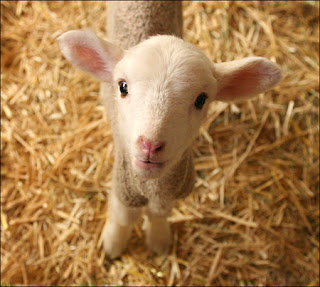 And the winner is....
The Lamb
The optimist in me won today. Many will disagree, but I would prefer to believe that for the most part, the general intent of the majority of people is good. Sure, there are a few who spoil it for everyone (like the majority of politicians), but the glass is half-full. Besides, have you seen how cute lambs are?
 And the winner is....
The Lamb
The optimist in me won today. Many will disagree, but I would prefer to believe that for the most part, the general intent of the majority of people is good. Sure, there are a few who spoil it for everyone (like the majority of politicians), but the glass is half-full. Besides, have you seen how cute lambs are?
10.6.11
Duke of Ferrera vs. Ulysses
We know that the Dramatic Monologue won in its category, but what will happen when we put 2 of the dramatic monologue's finest together and tell them to brawl? One's a duke, but one's a king, and a war hero, so who would win? The Duke of Ferrera, the speaker in Browning's My Last Duchess is powerful and wealthy, but also arrogant, with a twisted sense of justice, while Ulysses the speaker and title of Tennyson's poem (I think I'm docking points for the lack of creative title) was once mighty and powerful but is now aging, down but not out. Now while the Duke cannot deny that he has a violent streak a mile wide (He killed his wife-for smiling), it is implied that he is too good and proud and pompous to actually kill anyone himself. But Ulysses, he was in the Trojan war, so would have no qualms about killing, but hasn't had to do anything like that since the war, which was a long time ago. Ulysses is a king though, with an entire army to command, and how much power does a simple Duke of Italy have? How big is Ithaca anyways? I also wonder if Ulysses would actually make it to Italy, he is known for getting lost, and what's his status with the Grecian gods? That would easily determine his fate.
Who would win?
Ulysses
He might not be the youngest or strongest, but at least he isn't a slimy sociopath with a knack for taking people out, like he's the mob or something. Besides kings always beat dukes. It's like a cardinal rule of noblemen.
Who would win?
Ulysses
He might not be the youngest or strongest, but at least he isn't a slimy sociopath with a knack for taking people out, like he's the mob or something. Besides kings always beat dukes. It's like a cardinal rule of noblemen.
7.6.11
Dylan Thomas vs. Thomas Gray

Who would win......
Thomas Gray
Even if you just read through the poems, Gray's Elegy makes you think, think about your life and the lives of others cut short. Thomas' poem has a cool idea, but doesn't quite invoke the same emotional response.
5.6.11
George Gordon, Lord Byron vs. Alfred, Lord Tennyson
Two men with unnecessarily long names, 2 well-known greats of English poetry of 2 completely different eras, Byron was the leading Romantic poet of his time, Tennyson, a favourite of Queen Victoria during her reign. Both were known to be brilliant in their own time, both seized their lives and did what they wanted to do. Byron is known for his lengthy narrative poem Childe Harold's pilgrimage, Tennyson for his various body of works but especially for his works based on myths, like Ulysses. Byron was at the forefront of the Romantic period, and his poetry reflected the views of that time, respect the environment, challenge what was considered normal, and reject what the authority was telling them. So I guess he was really a hippy.... Tennyson was a more traditionalist reflecting the stability of the times. However, Byron wasn't the most stable guy, it is rumoured that he might have suffered from bi-polar, where as Tennyson was perfectly sane. Not entirely sure if this hurts or helps Byron, a lot of great people suffered from serious mental issues...One thing I know for sure is that Tennyson was born in Lincolnshire, and that's where many awesome people come from. I would know, I'm one. Now as for the actual body of work, Tennyson did produce more shorter works, where Byron produced fewer long ones. Byron did die when he was 37 though (WHOA! THE SAME AGE AS VAN GOGH!!), so that sort of accounts for that.
The winner is....
Alfred, Lord Tennyson
The final decision came to me when I realized that Byron did create the Byronic hero, which on it's own is fine. But when terrible authors like Stephenie Meyer get a hold of those things, tragedy happens. Essentially Byron created Twilight. Not cool...
The winner is....
Alfred, Lord Tennyson
The final decision came to me when I realized that Byron did create the Byronic hero, which on it's own is fine. But when terrible authors like Stephenie Meyer get a hold of those things, tragedy happens. Essentially Byron created Twilight. Not cool...
31.5.11
Pool C Begins!
Now that we've completed the first round of eliminations, we are 1 step closer to finding out the ULTIMATE LIT CHAMPION! Exciting isn't it? Now here's the lineup for the next round, there proves to be some interesting matches:
Geats vs. A Modest Proposal
Knight vs. Ulysses
Thomas Wyatt vs. Thomas Gray
Nymph vs. The Lamb
Satan vs. Mariner
John Milton vs. Robert Burns
Epic vs. Dramatic Monologue
Petrarch vs. Tennyson
Geats vs. A Modest Proposal
Knight vs. Ulysses
Thomas Wyatt vs. Thomas Gray
Nymph vs. The Lamb
Satan vs. Mariner
John Milton vs. Robert Burns
Epic vs. Dramatic Monologue
Petrarch vs. Tennyson
Subscribe to:
Comments (Atom)